With the given information we can create a table to organize the information:
| Cargo Units | Oper. Hours | |
| Truck A (x) | 1 | 3 |
| Truck B (y) | 2 | 1 |
| \(\geq12\) | \(\geq18\) |
The following restrictions can be interpreted:
$$x+2y\geq12$$ $$3x+y\geq18$$Objective Function: \(Z=x+y\)
Via a system of equations we can find the intersection:
$$\begin{cases}x+2y\geq12 \\ 3x+y\geq18\end{cases}$$Using the replacement method:
$$x=12-2y$$ $$3(12-2y)+y=18 \therefore 36-6y+y=18 \therefore y=\dfrac{18}{5} \therefore y=3.6$$ $$\\$$ $$x=12-2(3.6) \therefore x=12-7.2 \therefore x=4.8$$ $$(4.8, 3.6)$$Also we can check if both results satisfies the restrictions:
$$x+2y\geq12 \therefore 4.8+2⋅3,6 \therefore 4.8+7.2=12$$ $$3x+y\geq18 \therefore 3⋅4.8+3.6 \therefore 14.4+3.6=18$$Graphical Representation
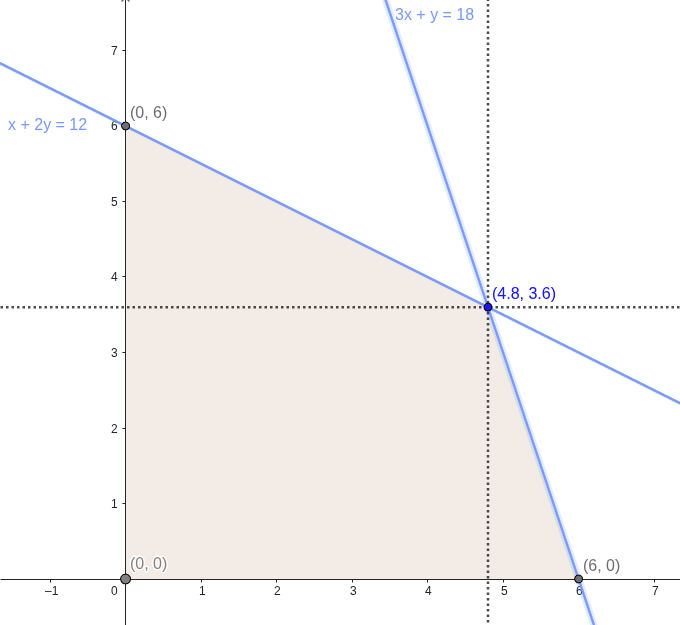
We can observe that the intersection is (4.8, 3.6).
$$Z=x+y \therefore Z=4.8+3.6$$ $$Z=8.4$$This means that together the two trucks make 8.4 travels, however, since we can't make a "half-travel", the values must be rounded to integers.
Re-evaluation with rounded values
$$x=⌈4,8⌉=5$$ $$y=⌈3,6⌉=4$$Testing both restriction again:
$$x+2y\geq12 \therefore 5+8=13$$ $$3x+y\geq18 \therefore 15+4=19$$This is a viable and integer solution, although slightly above the actual optimum (which was 8.4).
$$Z=x+y \therefore 5+4=9$$With that, we came to the conclusion that:
To meet the constraints with the smallest integer number of trips, truck A must make 5 trips and truck B must make 4 trips, for a total of 9 trips. Although this solution is slightly above the theoretical optimum of 8.4 trips, it makes the viability possible.